
Stone & Lime


Renovation of Structural Stone Building Elements
This project focused on the renovation of the most critical structural elements of a stone building. A severely damaged corner, deteriorated window and gate openings, and weakened masonry lintels all required attention. The objective was to address these vulnerable areas while leaving the structurally sound masonry untouched for future work.
The Challenge
Several areas of the building had developed significant structural problems. One corner had separated from the adjoining walls and deteriorated beyond safe local repair, while a number of window openings, lintels and gate openings also required rebuilding or reinforcement. The priority was to stabilise these vulnerable areas and prevent further deterioration of the structure.
Our Approach
The unstable corner was carefully taken down to sound masonry, the area was cleaned and prepared, and the corner was rebuilt in stone. Damaged window openings, lintels and gate openings were repaired or locally rebuilt where necessary. Simple timber windows were made, glazed and installed by us to protect the interior from the weather, and a new concrete entrance ramp was formed at the gateway.
The Outcome
The most vulnerable parts of the building were stabilised and returned to functional condition without extending the work unnecessarily to sound areas of masonry. The rebuilt corner, repaired openings and lintels, weather-protective windows and new entrance ramp allow the building to remain secure and usable while leaving further masonry work for a later stage.

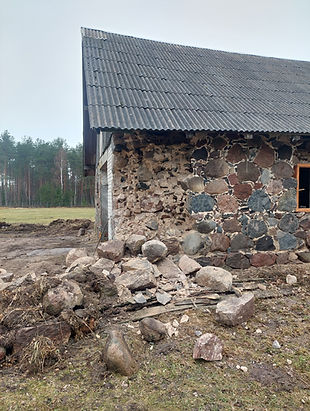
A Severely Damaged Building Corner
One corner of the building had separated from the adjoining masonry and deteriorated beyond the point where a local repair would have been sufficient. The unstable section therefore had to be taken down completely to sound masonry before the corner could be properly reconstructed.

Preparing the Original Stone for Reuse
Original stones recovered during dismantling are cleaned of loose and deteriorated mortar before being reused in the reconstruction. Preparing the existing material allows suitable stones to return to the building rather than being unnecessarily replaced, while also providing clean surfaces for the new lime mortar.

Raising the Timber Wall Plate to Its Original Level
A hydraulic jack is used to carefully raise the timber wall plate back to its original level. Once correctly positioned, it is supported by a stone individually shaped to fit beneath it, restoring proper support between the rebuilt stone masonry and the timber roof structure above.
Restoring the building's original form
As reconstruction progressed, the historic proportions of the building gradually returned. Careful stone selection and traditional lime mortar pointing ensured that the repaired section blended naturally with the surviving original masonry, creating a durable and visually authentic result.


Rebuilding the Window Openings
These two openings show examples of deteriorated and poorly formed masonry before reconstruction. Across the building, a total of twelve window openings required rebuilding. Unstable or unsuitable masonry was carefully dismantled and the openings reconstructed in stone, while sound surrounding masonry was retained wherever possible.

Completed Window Opening
After reconstruction, the window opening is properly formed in stone and fitted with a simple timber window made, glazed and installed by our team at the client’s request. The solution is intentionally practical, providing reliable weather protection while allowing further work on the building to be carried out at a later stage.
Structural stability restored
The rebuilt corner once again provides full structural support while respecting the original construction. By combining traditional craftsmanship with compatible conservation materials, the building has regained both its strength and its historic character without unnecessary replacement of original fabric.


Heritage Conservation Insight
Renovating an older stone building does not always mean repairing every surface at once. Identifying the areas that genuinely require structural intervention allows urgent problems to be addressed first, while sound masonry can remain undisturbed until further work is necessary or planned. A well-defined scope of work can be just as important as the repairs themselves.
