
Stone & Lime

Repointing a Stone House with Lime Mortar
This stone house had previously been extensively repointed with cement mortar, both externally and throughout the interior. Over time, serious moisture problems had developed inside the building, with persistently damp stone walls and mould beginning to appear. The project focused on removing the incompatible cement mortar and returning the masonry to a more appropriate lime-based system.
The Challenge
Traditional stone masonry needs to manage moisture differently from modern sealed construction. In this building, extensive cement pointing had created a hard, relatively impermeable layer across the masonry joints, restricting their ability to release moisture. Inside, the effects were clearly visible: the walls remained damp and mould had begun to develop in several areas.
Our Approach
The cement mortar was carefully removed from the joints throughout both the exterior and interior stonework. The joints were cleaned and prepared before the masonry was completely repointed with compatible lime mortar, restoring a more vapour-permeable joint system and allowing moisture within the masonry to dry more readily through the mortar joints.
The Outcome
Following the removal of the cement mortar and complete repointing with lime mortar, a noticeable improvement developed within the building. The stone walls became significantly drier, indoor humidity decreased and the interior felt considerably more comfortable. The masonry could once again manage and release moisture through a more compatible mortar system.
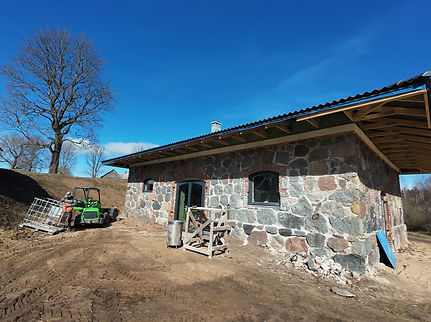


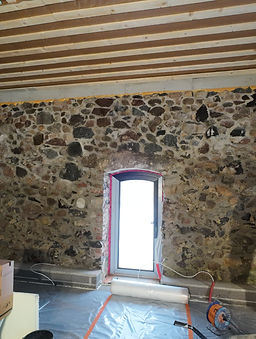
Stone Masonry Before Repointing
These views show the stone masonry before work began. The original joints had previously been extensively repointed with hard cement mortar, both externally and inside the building. Indoors, the walls remained persistently damp and mould had begun to develop, highlighting the serious moisture problems affecting the masonry and interior environment.
Removing the Cement Mortar
The cement mortar is systematically removed from the masonry joints, continuing down to foundation level. The joints are opened sufficiently deep to remove the incompatible material and expose sound masonry, creating the necessary base for complete repointing with lime mortar rather than simply covering the existing cement repairs.

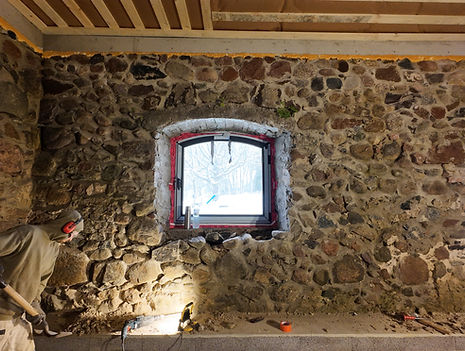
Cleaning the Interior Masonry Joints
The same process continues inside the building, where cement mortar is removed from the joints throughout the interior stone walls. The joints are carefully opened and cleaned to sufficient depth, preparing the masonry for complete repointing with lime mortar and restoring a more vapour-permeable joint system.

The Completed Lime Mortar Repointing
The completed project shows the stone masonry after the cement mortar was removed and the joints repointed with lime mortar throughout both the exterior and interior. Beyond restoring the natural appearance of the stonework, the change to a more compatible and vapour-permeable mortar system was followed by a noticeable improvement in the building’s indoor conditions.


Heritage Conservation Insight
The Right Mortar Matters
The mortar between the stones is an essential part of how traditional masonry performs. Hard cement mortar can restrict moisture movement and place unnecessary stress on the surrounding stone, while compatible lime mortar allows the wall to manage moisture more naturally. Repointing is therefore not simply about renewing the joints — it is about restoring the balance between the materials that make up the wall.
