
Stone & Lime

Granite Stone Wall Restoration
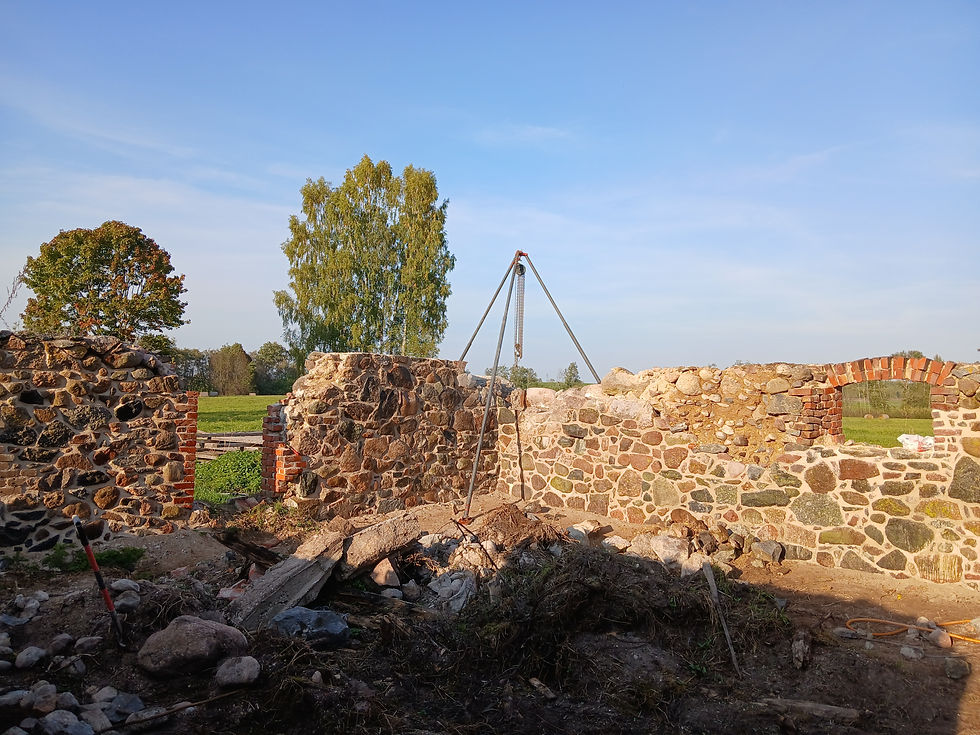
This project focused on the conservation and repair of deteriorated granite stone walls, where failing mortar joints and unstable masonry were beginning to compromise the structure. The aim was to stabilise the walls while retaining as much of the original stonework as possible and preserving the character of the existing masonry.
The Challenge
Years of weather exposure and deteriorated mortar had weakened sections of the stone walls. In several areas, joints had largely disappeared and individual stones had become unstable, increasing the risk of further movement and local collapse. Timely intervention was necessary before the damage progressed further.
Our Approach
Our approach focused on stabilising the masonry while preserving as much of the original construction as possible. Deteriorated joints were carefully cleaned, loose and unstable stones were repositioned where necessary, and damaged sections were locally rebuilt. Traditional lime-based mortar was used to remain compatible with the existing stonework.
The Outcome
The repaired walls are structurally stable again, while the original stones and overall character of the masonry have been retained wherever possible. Necessary reconstruction has been integrated into the existing stonework without unnecessarily replacing sound material, leaving the walls secure and ready to continue ageing naturally.

.jpg)
Assessing the original masonry
Before work begins, the condition of the stone wall is carefully assessed. Deteriorated mortar joints, loose stones and areas of movement help identify where intervention is necessary and where the original masonry can remain untouched. The aim is not to rebuild unnecessarily, but to retain sound original material wherever possible.
Securing the structure
Years of mortar deterioration had left individual stones poorly supported and vulnerable to further movement. Before more extensive repairs could begin, unstable areas of the wall were carefully secured. Sound masonry was retained wherever possible, while loose stones were repositioned only where necessary to restore stability to the structure.
Preserving the Original Stonework
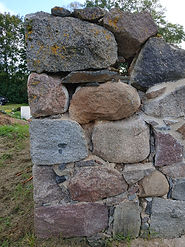
Traditional stone walls are rarely perfectly uniform, and this irregularity is part of their character. During repair, the objective is not to make the masonry look newly built, but to preserve its existing form. Original stones are retained and carefully worked around wherever the surrounding masonry remains sound.


Careful reconstruction
Where sections of the wall had become too unstable to preserve safely in place, the affected masonry was carefully dismantled and rebuilt. Original stones were reused wherever possible, maintaining the existing character of the wall while restoring the structural connection between the repaired section and the sound masonry around it.
Custom Equipment for Traditional Masonry
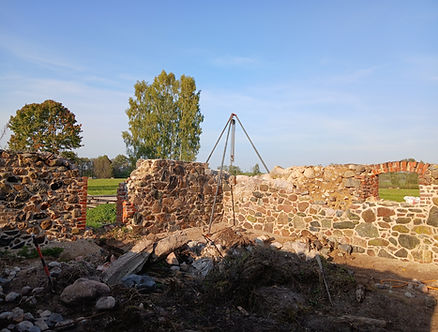
Large stones require controlled handling, particularly when working close to masonry that must remain undisturbed. A telescopic lifting tripod equipped with a chain block allows heavy stones to be lifted, rotated and carefully positioned, giving precise control while reducing unnecessary disturbance to the surrounding wall.

Rebuilding with the Existing Masonry
As reconstruction progresses, each stone is positioned in relation to the masonry already in place rather than forcing the wall into an artificially uniform pattern. Careful stone selection, stable placement and appropriate lime mortar allow the repaired section to become structurally integrated while retaining the irregular character of the original wall.


Working with Traditional Lime Mortar
Lime mortar is used to rebuild and repoint the masonry, remaining compatible with the way traditional stone walls were originally constructed. Rather than creating rigid joints around the stones, the mortar works together with the masonry and allows the wall to accommodate natural movement and moisture.

Historic Masonry Built to Last
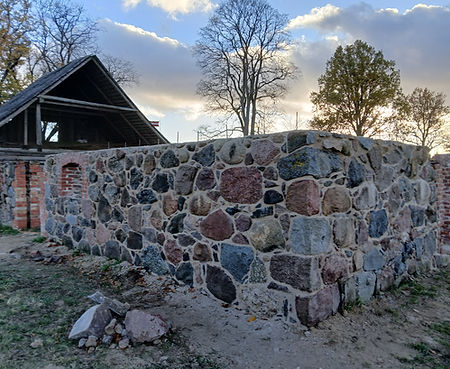
The completed stone wall reflects the strength and character of traditional masonry. Every repair was carried out using compatible materials and restoration principles, preserving the building's authenticity while ensuring its longevity for generations to come.
The longevity of a traditional stone wall depends on more than the durability of the stone itself. A stable foundation, careful stone placement and compatible lime mortar all contribute to a structure that can accommodate natural movement and moisture over time. Timely local repairs can often prevent much more extensive reconstruction later, while allowing the greatest possible amount of original masonry to remain in place.